A new narrative podcast set in a country town… and it’s NOT a true crime?
By: Kirsten Diprose, creator of Silver Ball Social Innovations: Warrnambool and founder, Rural Podcasting Co.
A rural town is perfect for the scene of a crime… in a literary sense, that is.
Authors know it, filmmakers know it… and podcasters have proven they do too. When it comes to rural podcasts in Australia, two of the most popular are found within the true crime genre: Lost in Larrimah and the US hit series S-Town (two brilliant podcasts).
So is there a problem with this? Some argue it promotes the idea of “rural decay” - that country areas are declining cultural backwaters,for people who couldn’t get out. And yes, it can be a little disheartening for any rural community that feels as though the world only cares about them, when something horrific has happened. The Gippsland community of Korumburra, has certainly been through this recently, during the trial of mushroom murderer, Erin Patterson.
But maybe we’re focusing on the wrong thing.

Kirsten Diprose outside the Larrimah Hotel, NT on a trip.
Learning from “true crime”...
I make no secret of the fact that I am a true crime fan. In fact, I recently went through Larrimah, a very remote town in the NT, where I went completely fan-girl, wandering around all the places that had been painted so vividly in my head by the podcast. Like many fans before me, I traced the steps of the last movements of Paddy Moriarty, who left the pub in 2017, never to be seen again. By chance, I then even got to meet the creator of Lost in Larimah, Kylie Stevenson, in Darwin a few weeks later (another fan-girl moment).
Clearly, I am not anti-true crime.
Rather, I am pro-rural. So, instead of lamenting the lack of media interest in rural Australia (unless it’s tragic and shocking), why don’t we focus on what we can learn from the successful narrative storytelling technique that true crime podcasters employ so well? Essentially, how can we take some of the components that make these podcasts so engaging… and apply them to create a story of a town that is inherently positive?
If we go back to old newsroom traditions, positive stories are harder to tell. “If it bleeds it leads” is the old adage. And to a certain extent this is true for podcast storytelling… true crime has so many compelling ‘news values’, such as tragedy, conflict and ‘the unexpected’… this is often mixed with deep reflection points around justice and morality. The medium of podcasting makes this even richer by using first person narrative storytelling, emotive soundscaping and place-based descriptions (where the host takes you there). The listener embarks on an emotional and intellectual journey, with compelling ‘characters’ and story arcs.
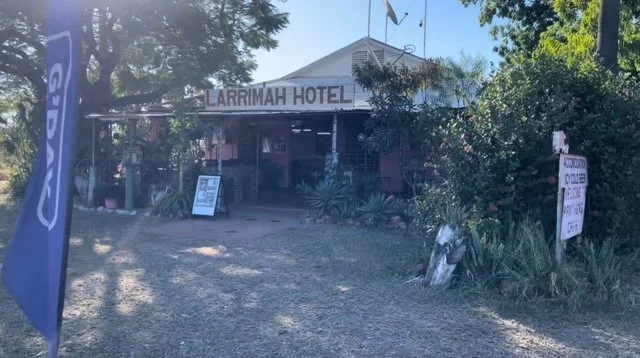
The Larrimah Hotel maintains its original look outside, but inside it has been renovated.
Turning “social innovation” into a story (true crime style)
So my latest experiment is to take these true crime techniques and apply them to a positive depiction of a town…telling Warrnambool’s story of social innovation. Over the past 10 years, several creative and inclusive groups have sprung up in this Victorian coastal town, bringing opportunities to the region, inspiring creativity and forging impactful partnerships. It's been wonderful to witness. So how do you capture this, in a way that’s compelling and memorable?
There’s plenty of research that links storytelling to memory, in ways that factual points do not. Our brains are wired to take in stories that help us explain the world and our place in it. This means, instead of focusing on what the ‘innovation’ is (i.e. a new technology) - it’s about uncovering the stories around it (the people involved, the place, the history… the intrigue).
So, in my latest podcast, Silver Ball Social Innovations: Warrnambool, I have deliberately applied some of the storytelling techniques of true crime… to analyse a positive change. These include:
Episodic story arcs - there is at least one story within each episode, where there’s a challenge that is discussed (and generally resolved).
First person narrative - I am not the story, Warrnambool is. But it’s told through my eyes, as a semi-local (I know the region well, I’ve worked there and live 60km north of Warrnambool, so I am a regular visitor). Listeners develop a para-social relationship with the host.
Probing Conversation - Of course, I am not uncovering a murder. But I am going deep in many of the interviews. This takes time. You won’t hear all the conversation in the episode, and there is generally a lot of relationship building that happens before I sit down with someone. The idea is to be able to elicit deep, thoughtful and personal insights.
Place-based - The interviews are done in place, picking up the natural sounds and enabling guests and myself to describe what they see. This allows the listener to connect, by triggering their own memory or painting a mental picture.
Historic ties - While the focus is heavily on recent developments in Warrnambool, there are deep ties back to historical events and people.
Continual thread - While perhaps not as strong as a murder investigation, there is a thread connecting each episode (social innovation)
Music and soundscaping - A key feature to increase the place-based aspect and used to shift the emotional tone throughout.
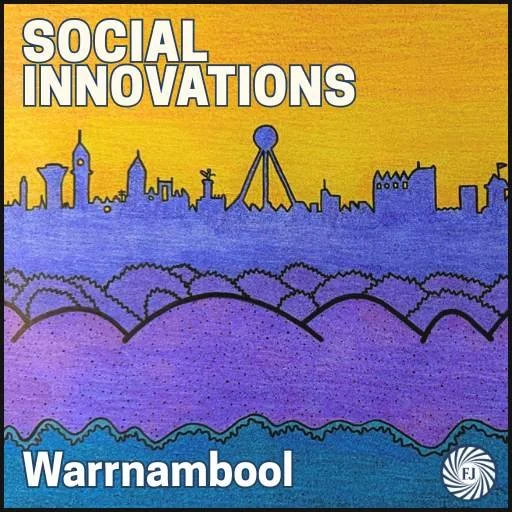
Cover art for, Silver Ball Social Innovations:Warrnambool
Now, will it work? I don’t have the backing of an extensive production team or access to a major distribution network. But I do have great community support, including from the Fletcher Jones Family Foundations who are willing to give this experimental and exciting approach a go.
Inside the podcast series, you will hear the stories of 6 change-making organisations:
One Day Studios
Find Your Voice Collective
Warrnambool Community Garden
Stoked Surf Therapy
Warrnambool College Indigenous Garden
F Project
No murder. Just inspiration (warning: this might still make you cry).
Make sure you hit follow on the podcast now, so you don’t miss an episode!
Kirsten Diprose is the founder of the Rural Podcasting Co, which helps individuals and businesses tell their own stories through podcasting. Her podcast is called Ducks on the Pond. Kirsten is also studying a PhD in podcasting and local news sustainability. She lives on a farm in south-west Victoria with her husband and two children.
For podcasting tips and recommendations, sign up to my Newsletter!